Have you ever wondered how the electricity being generated and transmitted to your home? It might be easier to switch on a light bulb and at that instance the bulb light up like the energy required to light up the bulb has always being there in some sort of a storage. But there is a good chance that the amount of energy that required to light up that bulb was generated by a power plant hundreds of kilometres away from your house and it got transmitted to you by electricity lines spans for hundreds of kilometres unless you have some sort of generating method like solar, wind or natural gas installed at your home premises. Electrical utility has become one of the most sophisticated and critical industries in the world due to the ever increasing demand for energy and the exponential growth in use of electronic devices in day to day activities. In my post today I am hoping to give you a little insight about the concepts used in electrical power engineering.
I’m pretty sure all of you have heard of things like voltage, current, Power, AC, DC, resistance and impedance. Most of us learn these at school and unless you peruse a career related to electrical engineering you might not have more complete idea about these concepts. Therefore I would like to talk about some of these in this post.
Electricity is basically the flow of charged particles. It can be positive or negative but due to the atomic structure of matter electrons are the ones that contributes to electricity most of the time. An electrical circuit is a closed loop that electrons flow from a higher voltage to a lower voltage doing work (releasing energy) on it’s way. This is not always the case but as long as there is a voltage potential difference between two points in space there is a possibility that a current will flow.
Voltage (V)
Voltage can be described as the potential difference between two points in an electric field. An electric field is similar to a gravitational field that occurs due to a presence of a mass. An electrical filed is caused by a charged particle. Voltage is just how we measure the amount of work being done when another charged particle being moved from one point in space to another point in space where there is a difference in electric filed. Although this explanation gives an insight on voltage this definition is not very useful when we are dealing with practical electrical engineering. In electrical engineering voltage is considered as an electromotive force that exists due to a voltage source like a battery or a generator.
There is one equation in electrical power engineering that is being used more often than any other equation. It is . In here P stands for the power being consumed/transmitted to an equipment. V stands for voltage at it’s terminal and I stands for current. If we want to transfer more power there are two ways to do so, by increasing voltage or current. If the power is kept at a constant value, the product of V and I is a constant. Therefore when voltage is raised current will go down and opposite is also true.
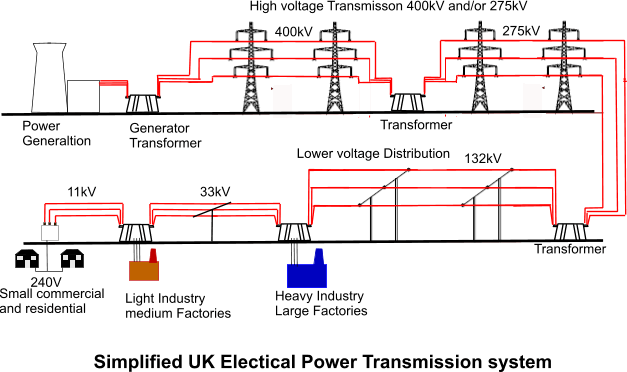
In Power transmission high voltages are preferred since using high voltages reduce the losses in occur in transmission lines. In Western Australia 132kV and 330kV voltage levels are used in transmission. But in HDVC transmission (High voltage DC) 800kV is also used. But when high voltages are being used safety becomes a major issue. But using higher voltages allows network operators to transfer more power over longer distances while minimising losses. Minimising losses in transmission is a major concern in power engineering. The power transfer happens in mega Watt scale (MW) therefore losses occur in transmission lines are also in MW scale. Engineers carefully design transmission lines, transformers and other equipment used in power transfer in order to mitigate this. The following diagram shows the different voltage levels that are being used to supply power from power plants to consumers. These voltage level could vary in different countries.

Image retrieved from https://anjungsainssmkss.files.wordpress.com/2011/07/electric_grid.gif
Current (I)
Current in a conductor is the amount of charged particles passing through a surface which is perpendicular to the direction of the flow measured in unit time. It can be expressed mathematically as I=Q/t where Q is amount of charged particles and t is time interval. You might think that when you plug an electrical apparatus to a port and switched on, the electrons that are in one end of the circuit will suddenly travel to the other end but what actually happens is that electrons are being pushed towards the positive end of the circuit under the influence of voltage. It’s much more like a traffic congestion where each vehicle will move very slowly but overall the traffic keeps going. The speed of an electron in a conductor is very small. This is called drift velocity of an electron (particle) caused by an electric field (difference in voltage).
Losses in a transmission line are caused by movement of electrons. The losses in a conductor can be modelled mathematically by P(losses)= (I*I)*R . I is the current flows through the conductor and R is the resistance of the conductor. So it obvious that if the current gets doubled in a line the losses will be increased by 4 times. This loss of electrical power will be dissipated as heat and will cause more troubles if it’s going to exceed the thermal capabilities of that line. Therefore network operators do their best to keep the amount of current being sent in a line at minimum. According to the current required to deliver the same amount of power will get increased if the voltage gets dropped. Therefore it’s very important to maintain the voltage levels at desired level. Uncontrolled voltage drops in an electricity networks can lead to a blackout which will have very bad outcomes.
Power(W)
When electrical engineers think about power it’s a bit different than the conventional power that most of us are familiar with. Most of us are familiar with Active Power which will be converted into other forms of energy like mechanical, heat or light. In electrical power engineering we use apparent power in almost all calculations. Apparent power consists of active power and reactive power. As I mentioned active power is the type which will be converted into useful energy. Reactive power is the power consumed by the network itself in order to keep it running. The following figure shows the relationship between Apparent, active and reactive power.

Image retrieved from http://solarprofessional.com/articles/design-installation/reactive-power-primer
The ratio between Reactive Power and Real Power is called true Power Factor of a system. Power factor angle is normally defined as the ratio between Apparent Power and Active Power. Cos(θ)=P/S
The power factor of an equipment will determine how much active power it will consume. For industrial loads power factor must be close to 1 (about 0.9) and utilities penalise the customers who don’t correct their power factor according to the specifications since less power factor means utilities have to supply more reactive power to deliver the same amount of active power. This cause lines to get overloaded.
Although Reactive Power may look like a by-product of generation actually it’s very important to keep the amount of reactive power in the network at a desired level. Voltage at a busbar is dependent on amount of reactive power available and failure to keep it at constant level will cause voltage instability problems in network. If the voltage levels get too low this will has a cascading effect over the network and will cause a blackout. Reactive Power is used to change the magnetic or electric fields of electrical equipment in network. Motors need reactive power to produce magnetic fields inside their stators. Reactive power is generated due to the phase difference between voltage and current in an equipment. S=√3*V*I Gives you the apparent power consumed or produced. All these quantities are vectors therefore they have both a magnitude and a direction. The following graphic demonstrate how apparent power being used in power transmission.

Image retrieved from http://electrical-engineering-portal.com/reactive-power-and-compensation-calculation-basics
It’s obvious in order to transfer more active power using the same line utilities have to reduce the amount of reactive power being transferred. Building new infrastructures like transmission lines is a capital cost to network provider and that is not their first option. Instead of building more lines to transfer power, a technique called reactive power compensation being used nowadays. This method is a very cost-effective, practicable way to supply reactive power. Capacitor banks are used to generate reactive power closer to where it’s being consumed. This approach will reduce amount of reactive power being transferred to site and reactive losses in network overall. Therefore network operator can deliver more active power to customer. And also reactive power compensation helps to mitigate line overloading. Capacitor banks are used in in compensation. Capacitors are capable of supplying reactive power to network.

Image retrieved from http//:electrical-engineering-portal.com
As shown in the diagram a portion of reactive power will be supplied by grid and the rest of the reactive power will be supplied by shunt capacitor. Qc=P(tanφ1-tanφ2) Equation gives the capacity of the capacitor required.

Image retrieved from http://electrical-engineering-portal.com
 sudaspace